Data Collection Methods: Types, Examples and Best Practices
Published Date: Feb 23, 2026
Key Takeaways
Data collection methods define data quality - the technique you choose directly affects the accuracy, reliability, and usefulness of your findings.
Primary and secondary data serve different purposes - primary data is collected firsthand for specific research goals, while secondary data draws from existing records, reports, and databases.
Qualitative and quantitative methods work best together - quantitative surveys show what is happening across a large group; qualitative interviews and focus groups explain why.
The right method depends on your questions - consider your goals, budget, timeline, and target respondents before choosing a data collection technique.
Small execution mistakes compromise results - pilot testing, training your team, and prioritizing data quality over volume are what separate reliable research from guesswork.
Data collection methods determine the quality of every research project, product decision, or business strategy. Without the right approach, even the best data falls short.
What are data collection methods?
Data collection methods are the systematic processes used to gather data from various sources for analysis and decision-making. They define how data is collected, where it comes from, and what tools are used to capture it.
Data collection techniques refer to a structured set of approaches, like surveys, interviews, observations, and experiments, that businesses and teams use to collect information relevant to their research questions.
Why data collection methods matter
Poor or incomplete data can lead to flawed analysis and costly decisions. The method you choose directly affects data quality, reliability, and how useful your findings actually are.
Here's why it matters:
Accuracy - The right collection technique ensures the data collected reflects reality, not noise.
Reliability - Consistent methods of data collection reduce errors and bias across your research.
Informed decisions - Clean, well-collected data supports data-driven decisions at every level.
Research integrity - From primary data to secondary data collection, your methodology shapes how credible your results are.
Data collection is the systematic foundation of any research. Without it, even the best analytics tools can't deliver meaningful insight.
Types of data collection methods
Not all methods work the same way. Some involve collecting primary data directly from sources, while others rely on existing records. Some capture numbers, others capture narratives. Knowing the different data collection types helps you match the right approach to your goals.
Primary vs. secondary data
Data sources in research fall into two broad categories, primary and secondary.
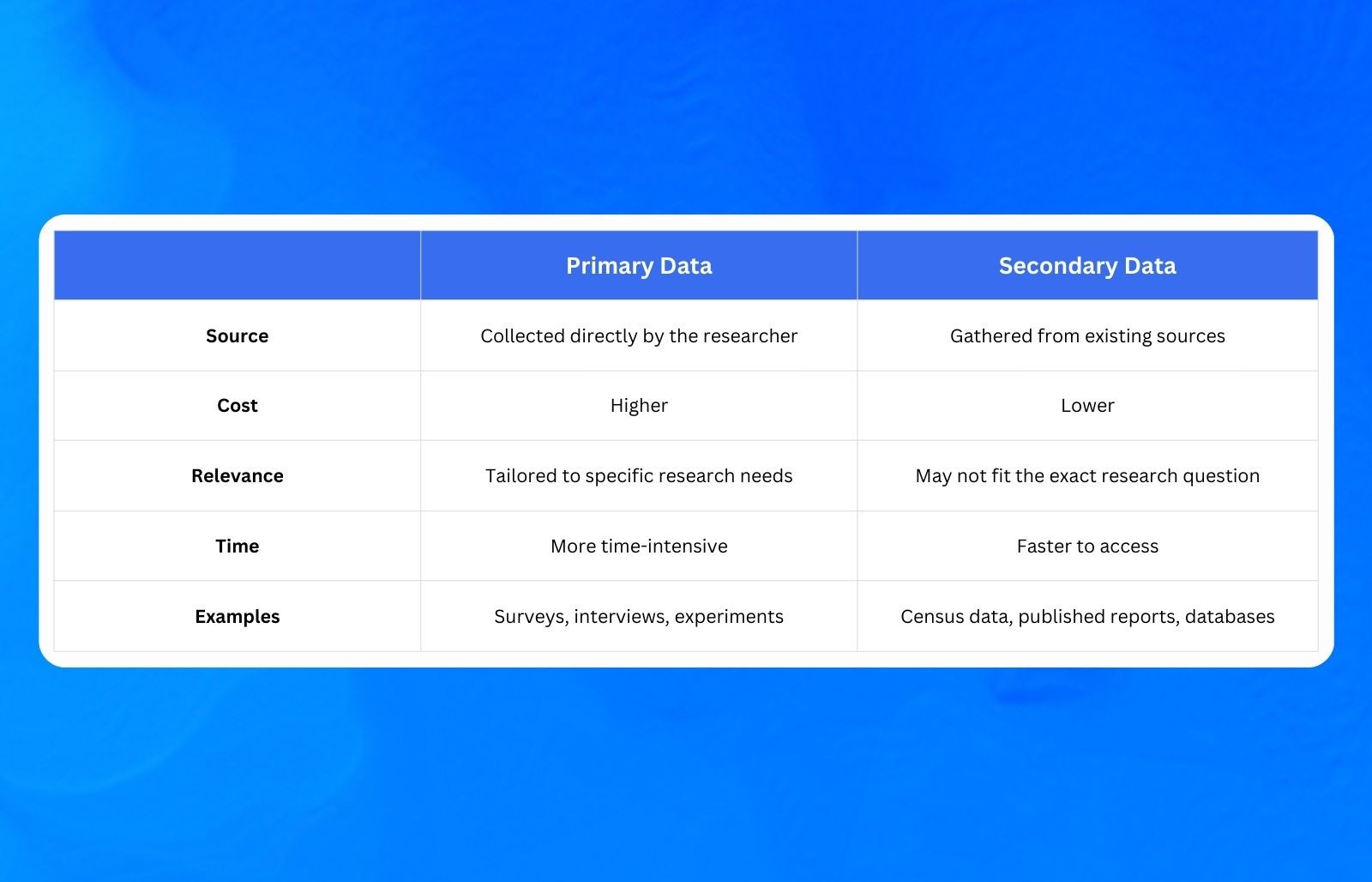
Primary data is collected firsthand for a specific research purpose. It's original, targeted, and directly tied to your research questions. Methods used for collecting primary data include surveys, interviews, focus groups, and observations.
Secondary data collection involves using data that already exists, published studies, census data, government reports, or industry databases. This approach saves time and resources, especially when a large amount of data is already available.
Here's a quick comparison:
Quantitative data collection
Quantitative methods focus on gathering numerical, measurable, and countable data. These methods are used when the goal is to identify patterns, measure variables, or apply statistical methods to draw conclusions.
Surveys and questionnaires
A structured set of questions sent to a large group of respondents. Ideal for collecting demographic data and measuring trends across a wide audience.
Experiments
Controlled settings used to test variables and measure outcomes. Common in scientific and academic research where precision and repeatability matter.
Structured observations
Researchers record specific, measurable behaviors or events under defined conditions, without interacting directly with subjects.
Digital data collection tools
Online data collection platforms that gather and process quantitative surveys in real time, making large-scale data collection faster and more efficient.
Quantitative methods work best when your research involves a large amount of data and requires statistical analysis. They're widely used in market research, data collection in higher education, and organizational analytics.
Qualitative data collection methods
Qualitative data collection methods capture non-numerical data, the why and how behind human behavior, opinions, and experiences. These methods produce rich, descriptive insights that quantitative surveys alone can't provide.
In-depth interviews
One-on-one conversations that allow businesses to explore a respondent's perspective in detail. Best for topics where context and nuance matter more than numbers.
Focus groups
Small group discussions guided by a moderator to gather diverse viewpoints on a topic. Useful for capturing shared experiences and group dynamics in a single session.
Observational methods
Researchers observe and document behavior in a natural or structured setting without interference, capturing what people do, not just what they say.
Open-ended questionnaires
A set of questions that allow respondents to answer in their own words, generating rich qualitative data that structured surveys can't capture.
Qualitative research is especially valuable in the early stages of a research project, when you need to explore ideas before deciding which quantitative data collection methods to apply.
Together, qualitative and quantitative methods give businesses a complete view of the data, numbers that show what is happening, and narratives that explain why.
5 Common methods of data collection
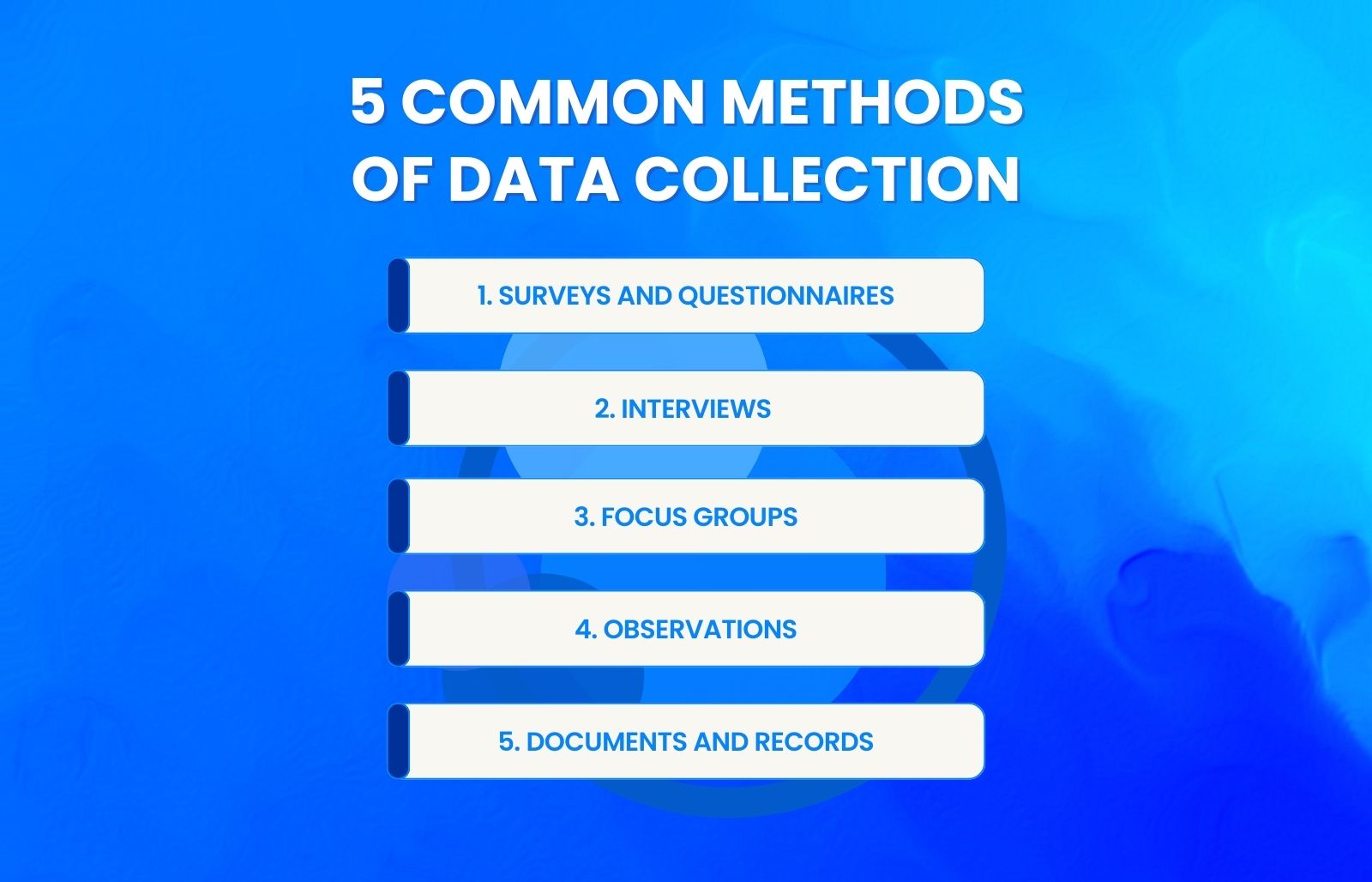
Surveys and questionnaires
A structured set of questions distributed to a group of respondents. Best for collecting quantitative data at scale, market research, and data collection in higher education.
Example: A university surveys students on course quality to make data-driven curriculum decisions.
Interviews
Direct one-on-one conversations between a researcher and a respondent. Best for qualitative research requiring in-depth responses and primary data collection in social or behavioral research.
Example: A product team interviews 20 customers to gather qualitative data on pain points before a feature launch.
Focus groups
A small group discussion guided by a moderator to gather diverse perspectives. Best for exploring audience opinions and collecting primary data on product concepts or services.
Example: A marketing team runs a focus group to gather qualitative data on how a new product is perceived before launch.
Observations
Systematically watching and recording behavior as it naturally occurs, without directly interacting with subjects. Best for behavior data in real-world settings and validating data from surveys.
Example: A UX researcher observes how users navigate a website, recording clicks and drop-off points to identify friction without relying on self-reported responses.
Documents and records (secondary data)
Gathering data from existing reports, databases, and official records. Best for research projects with limited time or budget, and for accessing large amounts of historical or demographic data.
Example: A policy researcher uses census data and health records to analyze healthcare access trends over ten years.
Steps in the Data Collection Process
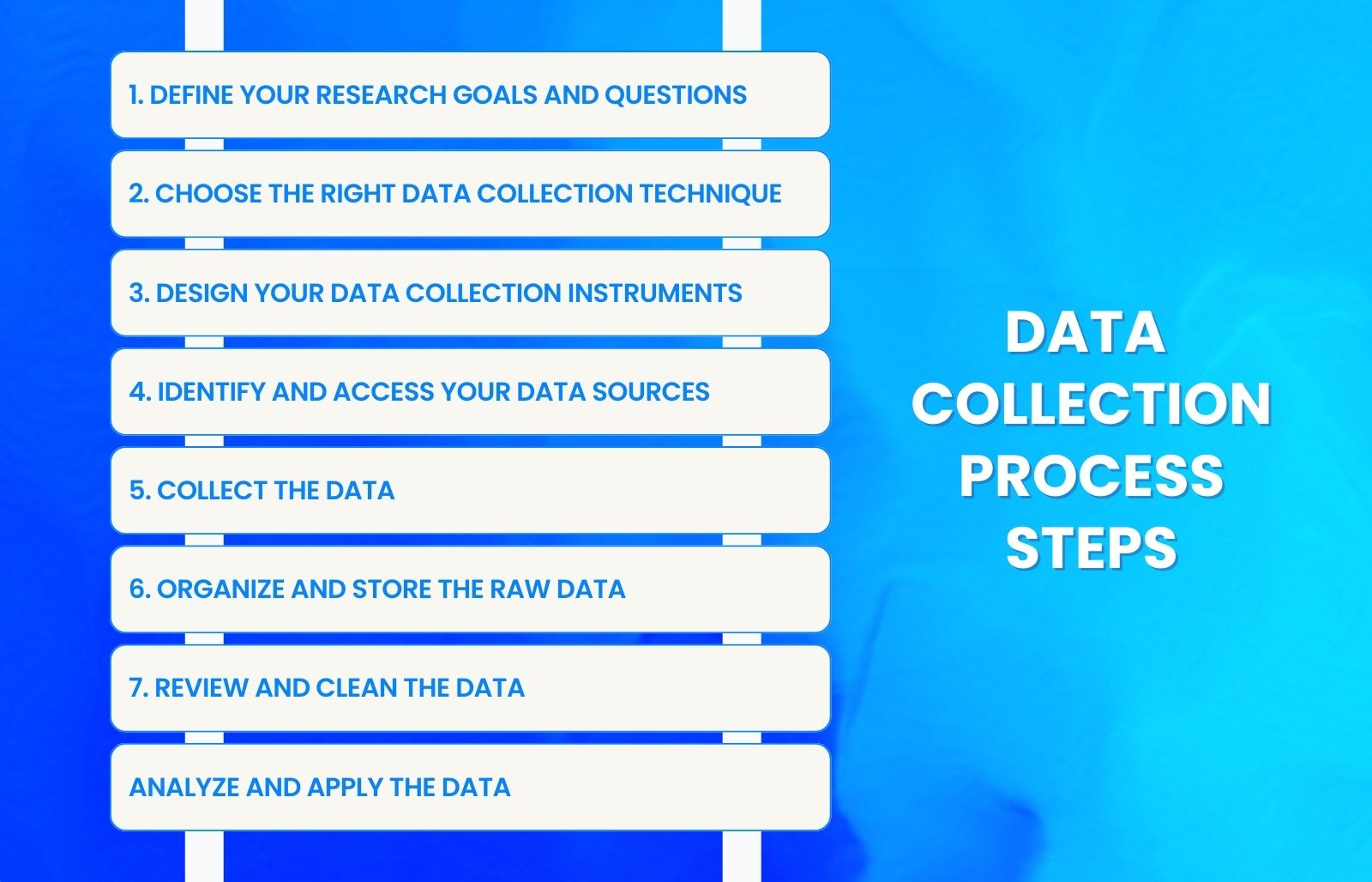
A well-structured data collection process separates reliable research from guesswork. Following a clear, systematic sequence ensures the data collected is accurate, consistent, and ready for analysis.
Step 1: Define your research goals and questions
Start with a clear purpose. Defining your research questions at the outset keeps the entire process focused and prevents collecting data that doesn't serve your goals.
Step 2: Choose the right data collection technique
Select the most appropriate data collection technique based on your research questions. Decide early on whether to use primary or secondary data collection, qualitative or quantitative methods, and which data collection instruments best fit your research.
Step 3: Design your data collection instruments
Build the tools you'll use to gather data, surveys, interview guides, or observation checklists. Well-designed data collection instruments directly impact the quality and reliability of what you collect.
Step 4: Identify and access your data sources
Determine where your data will come from. For primary data collection, this means reaching the right respondents. For secondary data collection, identify credible databases, published reports, or census data relevant to your research.
Step 5: Collect the data
Apply your chosen collection techniques consistently across all respondents and data sources. Monitor the process in real time to catch incomplete data early and reduce bias throughout.
Step 6: Organize and store the raw data
Sort, label, and store raw data securely before moving to analysis. Group data by source, method, or respondent category and back everything up. Poor organization at this stage can compromise data quality.
Step 7: Review and clean the data
Check for missing responses, duplicate entries, and outliers that could skew statistical analysis. Incomplete data can lead to inaccurate conclusions, this step should never be skipped.
Step 8: Analyze and apply the data
Apply the appropriate statistical or qualitative methods to the cleaned dataset. The goal is to extract meaningful insight that supports informed, data-driven decisions.
Best practices and tips for data collection
Even with the right method in place, small mistakes in execution can compromise your results. These best practices help businesses and teams collect data that's accurate, ethical, and genuinely useful for decision-making.
Align your method with your research goals - start with the question, then choose the data collection technique that directly serves it
Use the right tools for the job - match the data collection instrument to the scale and complexity of your research; tools like Formflow make it easy to build surveys, apply conditional logic, and manage responses all in one place
Pilot test before full deployment - run a small test with a few respondents to catch confusing questions, gaps, and technical issues early
Train everyone involved - consistent methods across all team members reduce bias and protect data reliability
Prioritize data quality over volume - a smaller, well-gathered dataset is more valuable than a large amount of poorly collected data
Respect ethical standards and respondent privacy - obtain informed consent, keep data secure, and be transparent about how it will be used
Combine qualitative and quantitative methods - quantitative surveys show what is happening; qualitative interviews and focus groups explain why
Document your data collection process - record methods used, data sources accessed, and any changes made to support transparency and reproducibility
Frequently asked questions
How do I choose the best data collection method for my research?
You choose the best data collection method by starting with your research question and decision goals. Then weigh factors like budget, timeline, sample size, and access to respondents. For example, a nationwide attitude study may favor online surveys, while a deep user research project leans on interviews and observations.
When should I use primary data instead of secondary data?
Use primary data when you need specific, up-to-date insights that existing sources cannot provide. It is best for answering narrow questions, testing new ideas, or exploring emerging behaviors. For instance, a startup validating a new feature would run customer surveys or interviews rather than relying only on industry reports.
Which tools are most useful for modern data collection projects?
Modern data collection relies on digital platforms that simplify survey delivery, integration, and quality checks. Formflow brings all of this together, from building surveys with conditional logic and tracking responses in real time, to exporting clean datasets directly into your analytics workflow.